We've all been there. You're sitting with a brilliant idea, ready to create something amazing. But then it hits you: "Where on earth do I start?"
You open a blank file. The cursor blinks mockingly. Imposter syndrome knocks on the door. "Maybe I should just watch YouTube tutorials for three days first?" you think.
This is where starter kits come into play – and when they're good, they're really good.
What's the Real Problem?
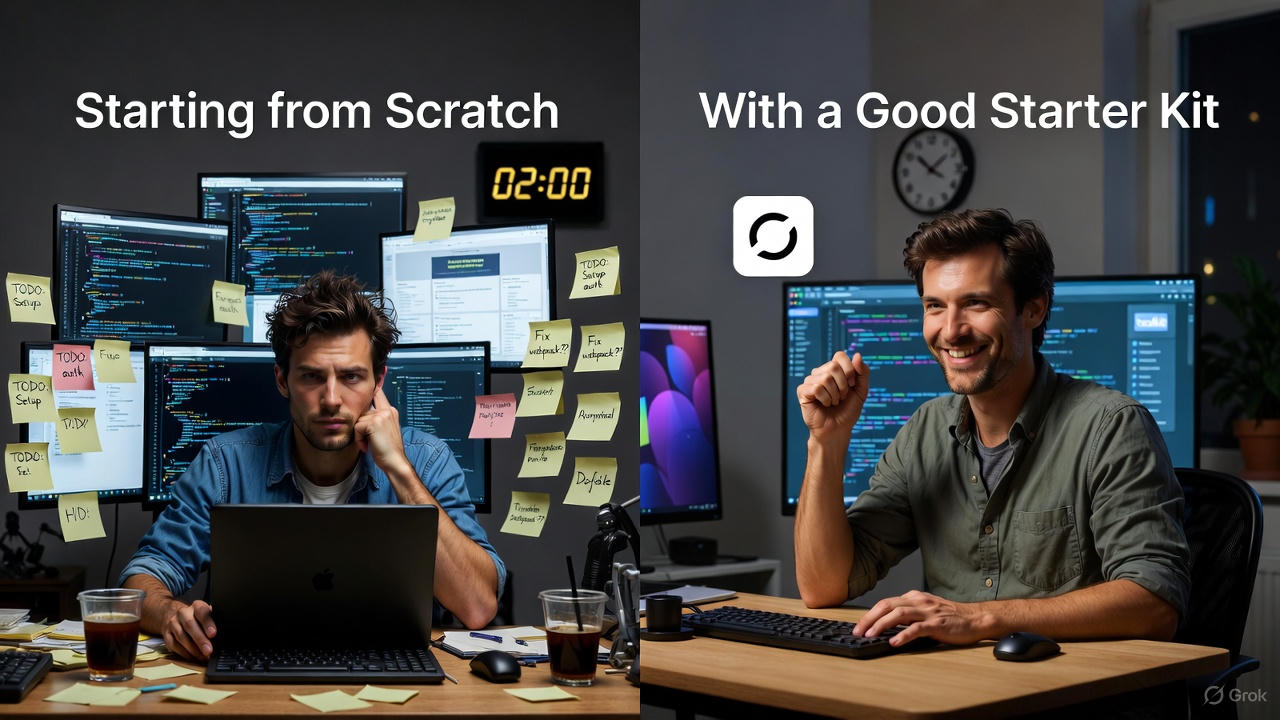
Let's be honest: starting from scratch is overrated. Setting up authentication for the twenty-fifth time? Configuring the build process again? Debating folder structure with yourself at two in the morning? This isn't value-creating work. This is what you do before the fun begins.
Starter kits take this boring, repetitive groundwork and wrap it up in a neat little box with a bow on top. They say: "Hey, we've solved the tedious stuff. Now you can focus on what actually matters."
The Benefits Are Obvious (When the Kits Are Good)
1. The Barrier Disappears
Remember that time you wanted to learn something new, but the documentation was a nightmare to navigate? A good starter kit is like having a friend who's already walked the path before you. "Here, I've set everything up. Just click here and see what happens."
Suddenly, you're no longer a beginner staring at an intimidating mountain wall. You're up and running. You're experimenting. You're learning by doing.
2. The Learning Curve Actually Becomes Fun
There's a reason people love Lego more than raw plastic and an injection molding machine. With a starter kit, you see results immediately. You tweak a setting, refresh the page, and BAM – something has changed.
This is learning through moments of magic. And when learning feels magical, you keep doing it.
3. You Get Value Right Away
Sometimes you just need something that works. Maybe you're prototyping an idea. Maybe you're testing whether a concept holds water. Maybe you just want to build something cool over the weekend without spending Friday night configuring webpack.
A good starter kit gives you this: immediate, concrete value. You can actually build something instead of configuring something.
But (And It's a Big But)...
Here comes the twist: Not all starter kits are created equal.
There are kits out there that are like buying a pre-packaged salad that's been in the fridge for two weeks. Looks fine on paper, but when you open it? Not good.
Bad starter kits can:
Be built by someone who didn't quite know what they were doing
Have hardcoded values everywhere (because "it worked on my machine")
Include 47 dependencies you'll never use
Have documentation consisting of "Installation: Run it and it should work"
Teach you bad habits that you'll later have to unlearn
So How Do You Choose Wisely?
Here's my checklist:
Look at who made it. Is it someone with experience? Someone who actually uses the technology in production? Or is it someone's first project that they uploaded because it looked cool?
Check how active it is. When was the last commit? Are issues being answered? Or is it abandoned like a ghost town?
Read the documentation first. Yes, before you install. If the documentation is chaotic or non-existent, the code probably is too.
Look at the dependencies. Does this starter kit really need 15 different packages just to display "Hello World"? Or is it lean and sensible?
Match it with your goals. Are you learning? Choose something pedagogical. Need to ship fast? Choose something battle-tested. Just want to play? Choose something that looks fun.
My Experience
I've used both fantastic and terrible starter kits. The best ones have saved me literally days of work. They've taught me best practices I didn't even know existed. They've made me actually finish projects instead of giving up in configuration hell.
The worst? They've cost me hours of debugging, frustrated Stack Overflow searches, and the kind of headache you only get from reading other people's bad code.
The Conclusion
Starter kits aren't cheating. They're not "training wheels." They're tools – and like all tools, it depends on how you use them and what quality you choose.
If you choose wisely – if you take the time to find kits that are well-built, well-documented, and well-matched to what you actually want to achieve – then they're worth their weight in gold.
They remove the boring stuff. They accelerate learning. They let you focus on what actually matters: building something cool, solving a problem, learning something new.
So next time you're sitting there with an empty file and a blinking cursor, ask yourself: "Do I really need to reinvent the wheel? Or can I stand on the shoulders of those who came before me?"
Often, the smartest choice is to say: "Thank you, dear starter kit, for making my job easier. Now I'm going to create something amazing."
PS: Next time someone says you "should learn to build everything from scratch," ask them when they last built their own JavaScript runtime. Or their own operating system. Abstraction isn't the enemy – it's how we build complex things without going insane.